An office clearance goes wrong in predictable ways: the building refuses access, the IT equipment leaves without being wiped, or the job overruns into Monday morning. Here is how to plan one properly, whether you are relocating, downsizing or handing a unit back to the landlord.
Clearance, strip-out or reinstatement?
These three words get used interchangeably, but they are different jobs, and mixing them up is how budgets go wrong.
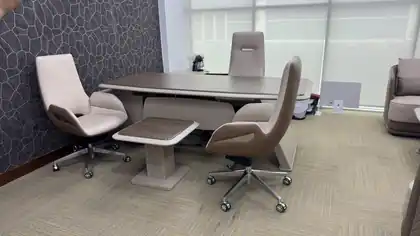
- Clearance means removing loose contents: desks, chairs, storage, appliances, archive boxes and IT equipment.
- Strip-out goes further and removes fitted items such as partitions, raised flooring, joinery and meeting-room glass.
- Reinstatement returns the unit to the condition set out in your lease, often a bare shell or a basic fitted state, which can include ceiling, lighting and services work.
Read your lease before you ask for quotes. If it requires reinstatement, you will need a fit-out contractor for the building work. A clearance company handles the contents and can take the debris away once the contractor has broken it out.
Start with the building, not the furniture
Most commercial towers in Dubai and Abu Dhabi require advance notice for any strip-out. Expect to arrange:
- A works permit from building management
- Booked service lift slots, often outside business hours
- Insurance and trade licence details for the contractor
- Approved access routes and loading bay times
This paperwork takes longer than the clearance itself. Start it two weeks out.
Separate the IT equipment early
Anything that stored data needs its own process. Servers, desktops, laptops, copiers and network hardware all retain information, and copier hard drives are the ones people forget. Decide before clearance day whether devices are being wiped internally, destroyed, or handed to a processor under a chain-of-custody record.
Leased equipment is a separate trap. Copiers, printers and sometimes laptops belong to the leasing company and must go back to them, not into a disposal load. Check your contracts and label leased items clearly before the crew arrives.
Work out what has value
Before you write off the whole fit-out, three categories are usually worth recovering: recent ergonomic task chairs, height-adjustable desks, and any branded meeting-room furniture. Everything else, including most partition systems and older workstations, generally costs more to store than it returns.
If you are moving rather than closing, decide what goes to the new office before anything else. Tag it clearly. Clearance crews move fast, and an untagged chair that was meant for the new office will leave with everything else.
Archives and paper records
Filing cabinets full of old contracts, payroll and client files are a data risk just like hard drives. Check what your business is required to keep and for how long, move anything you must retain into storage, and have the rest shredded rather than thrown into a general load.
Clear out of hours
The disruption is the real cost of an office clearance, not the invoice. Evening and weekend work means your team arrives on Monday to a finished space. Building management usually prefers this too, since it keeps lifts and loading bays free during the day.
Get the paperwork
For commercial clearances, ask for a licensed disposal certificate. Landlords increasingly require evidence of compliant disposal before releasing a deposit, and sustainability reporting may need it too. We issue documentation on every job, and our guide to where junk goes after collection explains how office furniture, metal and electronics are recovered.
A sensible timeline
- Two weeks out: permits, lift bookings, contractor details submitted
- One week out: IT equipment separated, leased items labelled, asset list agreed, quote fixed
- Two days out: staff clear personal items and desk contents
- Clearance day: out-of-hours strip-out, sweep, handover
Office clearance checklist
- Lease checked for clearance or reinstatement requirements
- Building permit and lift slots confirmed in writing
- Items for the new office tagged
- Leased equipment separated for return
- Data devices wiped, destroyed or handed over with records
- Paper records retained or shredded
- Disposal certificate requested
Where we work
Most of our Dubai office work is in Business Bay and Downtown Dubai, and we clear commercial units in Al Majaz, Sharjah and across Abu Dhabi. We handle strip-outs across all seven Emirates and can work around your hours.
Frequently asked questions
How long does an office clearance take in Dubai?
The clearance itself is often a single evening or weekend for a small to mid-sized office. The building permit and lift bookings usually take longer, so start those around two weeks ahead.
Can you clear our office outside working hours?
Yes. We regularly work evenings and weekends so your team is not disrupted and the building's lifts and loading bays stay free during the day.
What happens to computers and data devices?
Data devices should be wiped, destroyed or handed to a licensed e-waste processor with records. Tell us about them when you book so they are handled separately from the general load.
Do we get a disposal certificate?
Yes. We are a licensed waste transporter and issue a disposal certificate with every job, which landlords and sustainability reports often require.
Is office clearance the same as reinstatement?
No. Clearance removes contents like furniture and equipment. Reinstatement returns the unit to the condition in your lease and needs a fit-out contractor for the building work.
Tell us about the space or send photos on WhatsApp and we will quote a fixed price.